|
Descending the ridge down into Whalers Bay we caught sight of two figures standing on the beach in front of a small shack.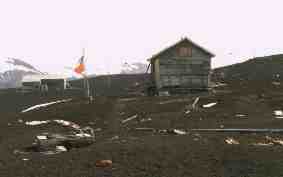 We noticed the small dilapidated building before, thinking it to be part of the Norwegian were university students
spending the short summer studying penguins. The Chilean Navy dropped them off at Deception Island about a month earlier and will return to pick them up in six weeks. Communication was difficult as they did not know much
English and we did not know very much Spanish. My guess was that they were the lowest budgeted Antarctic Expedition ever. One valued commodity they possessed was a seemingly endless supply of fine Chilean wine that they
shared very generously. That night, over wine and spaghetti, our guest told us that there was an Argentine Geological Research base a few miles from here.
They have a fresh water well and that we will be able to replenish our tanks. Our Chilean guests told us about the hot springs located at the far end of the caldera, but we do not know if we will visit them.
After an uninterrupted night at anchor, (there are few if any icebergs inside the caldera), we pulled anchor and motored to
the Argentine Base about nine miles distant. Farther inside the caldera the surrounding terrain became more volcano like with
many areas producing plumes of steam. The beaches in short sections emitted clouds of steam that shrouded them like a
North Pacific fog, while one-hundred feet high walls of ice formed dramatic backdrops to other sections of beach. Fog appeared to hug the hillsides' probity caused by steam vents.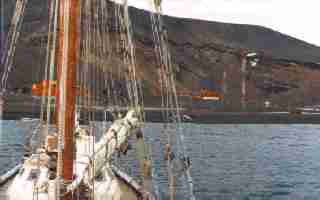 A group of red painted buildings in a small cove appeared to
port. At first the base appeared to be abandoned but as we set our anchor a few people appeared among the buildings. Our first order of business was to launch the Boston Whaler and reach those ashore. After
landing and shaking hands with the scientist ashore a few minutes of silence passed until one of our expedition pointed to one of the buildings and said "casa." This must have been a self invitation as we were soon
enjoying coffee and biscuits in a building that was obviously the cook shack. After the first cup of coffee, the silence ended, even though communication was difficult because of the language barrier. Talking
with our host a few minutes we learned that there are twelve scientists at the base studying the frequent volcanic activity in the area. The base
would normally accommodate upwards of fifty scientists and support personnel, but that number has been limited to
twelve due to lack of funding from the Argentine government. Being told to help ourselves to all the freshwater we needed
we began to transfer about 150 gallons. Meanwhile, the Matahiva rafted alongside with plans of also replenishing their
freshwater supplies. With our combined forces the water transfer became less of a hassle. As the others transferred water we
decided that we would exchange some crew with the Matahiva during our sail to the Melchoir Islands. The winds had
become light northerly and the skies were clearing so we decided to leave when the water transfer was complete. The
Melchoir Islands lie about one-hundred fifty miles to the south-west and should take us less than twenty-four to transit the distance.
ANTARCTIC VOYAGE PART 2
RETURN TO HOME PAGE
|